It's so nice to meet you, I'm Jingyi.
I design AI products where people stay in charge.
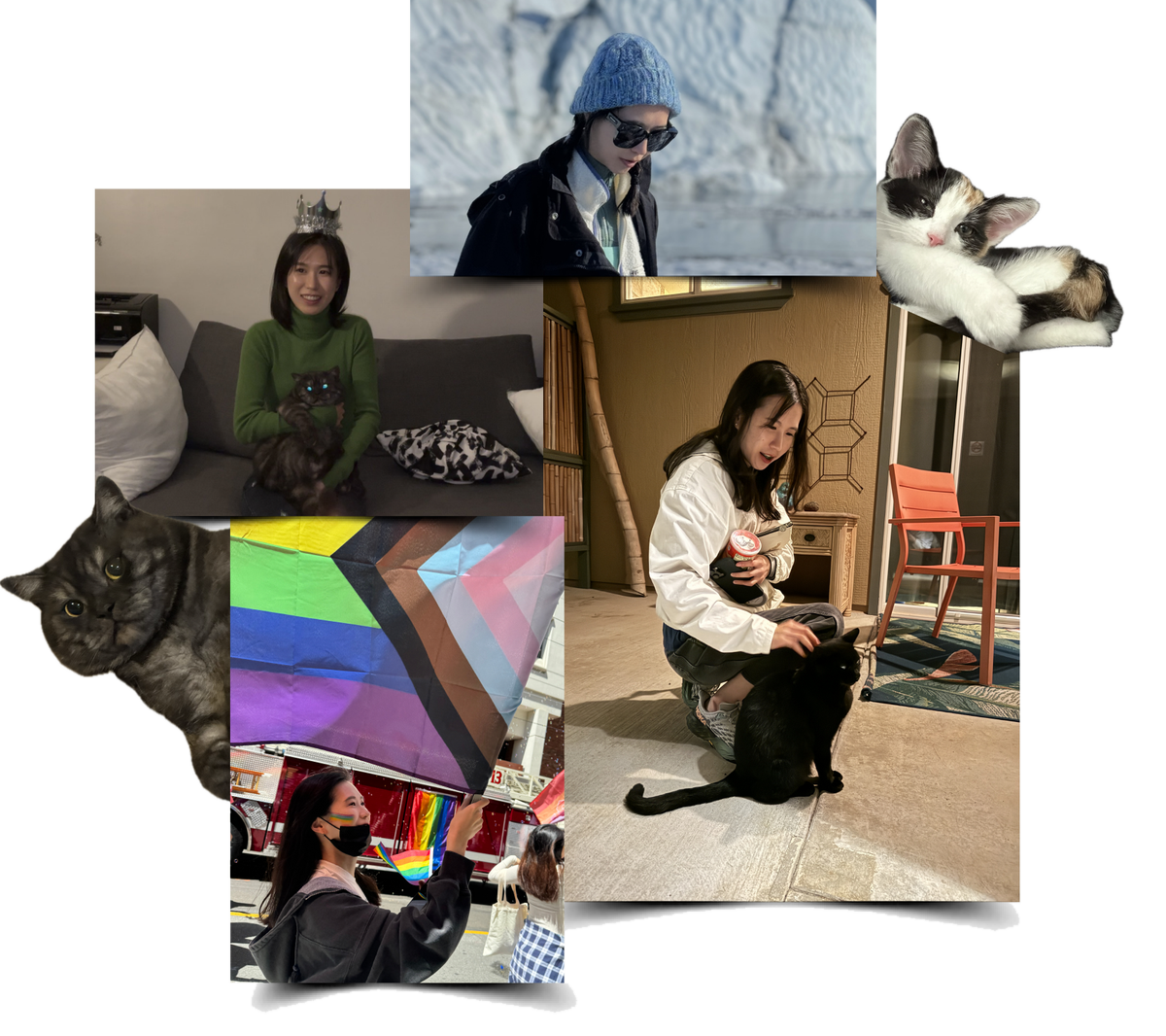
The human behind the pixels
Hello world!
I'm Jingyi Zhu, a product designer in the Bay Area. I work on complex AI products: the kind where an agent does real work, and a person still needs to understand it, check it, and make the final call.
Lately that has meant an AI co-scientist for materials R&D and an AI employee for finance teams, both built from zero, along with AI tools for creators and brands, and seller payments at eBay. I like owning the whole arc, from framing the problem to prototyping it in code.
Off the clock, I'm a full-time cat mom 😺, a self-taught photographer 📷 and an astrology enthusiast 🔮. You'll find me hiking in spring and fall, skiing in winter, and swimming in summer.
My take on AI product design
The through-line in my work
People keep asking whether AI will replace designers. It's the wrong question. As models grow more autonomous, the bottleneck moves from capability to context, and the designer's role moves with it: from Human-in-the-Loop, approving each step, to Human-on-the-Loop, setting direction and stepping in where it matters. When anyone can generate a hundred screens in a minute, judgment becomes the scarce thing, and the layer I design is what makes that autonomy trustworthy.
Human-on-the-Loop is the shape I design for: the person keeps direction and the final call, while the AI carries the work between the gates.
My design process
So my process flexed to match. Research still comes first, but instead of describing an idea I now build a working version, test real behavior in days, keep what holds, and cut what doesn't. Non-linear, quick to test and correct.
What vibe coding changed
Same rigor, less guessing. AI does the grunt work, but for B2B I still book the demos and dig in myself, and I hand off a running branch, not just a file. The tools change every month. The judgment doesn't.
Frame & plan
Claude as my thinking partner. I set the direction and write the prompts.
Explore & prototype
Vibe-code it
Build it for real
Validate in-browser
Review & merge
Ship
Live in production.
Let's work together.
I'd love to hear about new opportunities, anything design related. If you're building something ambitious and want someone to own the messy middle with you, let's talk.